Tuesday, 21 October 2014

Thriller Conventions

Thriller Conventions-
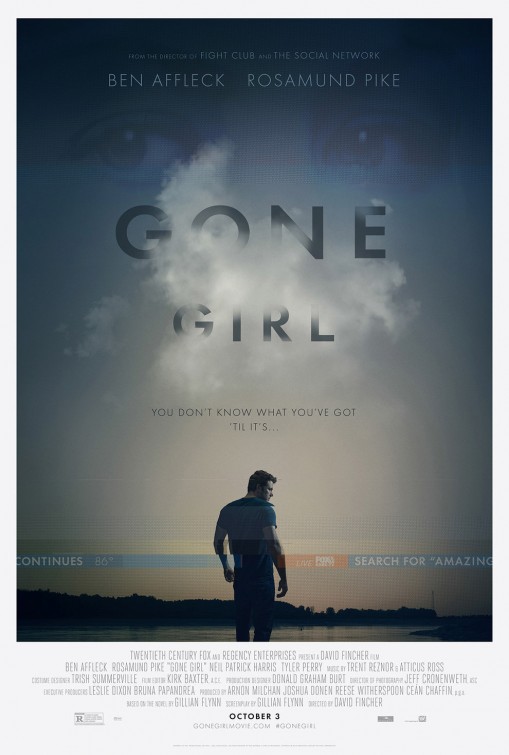
A Thriller is a fast paced film that is frequently filled with action and excitement to keep the audience on the edge of their seat. A thriller is normally consists of a hero and and a more powerful villain that he or she has to destroy and overcome. The normal plot of a thriller is that the villain presents obstacles for the hero to overcome. Some examples of deceives that are used in thrillers are as follows; Suspense, Red herrings and Cliff hangers. An example of a thriller that uses all of these conventions is Gone Girl. The film Gone Girl is a thriller about how a mans wife disappears and before he even becomes to come to grips with her strange disappearance he becomes the main suspect in this mystery. Thrillers can often overlap with mystery stories however they re clearly distinguished by the structure of their plots. This Gone Girl thriller was unlike no other as there was no murder to be solved and no obvious evil/villain. However this thriller used many of the same thriller conventions that are used in all thriller. The suspense in Gone Girl was created by the fact the mans wife had disappeared and had what he was now figuring out another alternative life without him. This created suspense as it made the audience unaware of what was going to happen next in the movie, which is exactly what happens in most thrillers. Thrillers are said to create a fearful excitement and you can definitely tell that from this movie the director has created this.

Jaws Opening SceneA cliff hanger is a plot device mostly used in a fiction story line that involves the main character being put in a difficult dilemma, and even in some case a situation of confrontation with another character. This device is used to make the audience want to watch on to see if this dilemma or problem ever gets solved.
A red herring refers to something that misleads or distracts the attention from the relevant issues. This device brings the characters to a false conclusion misleading them from the truth.
Cliff hangers and Red herrings are there to create suspense and engage the audience by doing this. A good examples of how a thriller does this is in jaws.

Hitchcock once said that thriller's allow the audience 'to put their toe in the cold water of fear to see what it's like.'

Some of the key features in a thriller are the; low key lighting, quick cuts, shadows, changes in angle shots, diegetic sound of heavy breathing, dramatic music.

The Semantic Code/ Symbolic Code. 
This codes uses connotations to keep the reader guessing if there are other meanings to the whats going on in the thriller.  For example in the film 'The Da Vinci Code' there is a series of hints and clues that are there to help the main characters solve the mystery of the Holy Grail.

The Enigma Code
This is the is the idea that the text is read and understood in different ways. For example if a thriller starts with a dead body, then the audience immediately question who the killer is and they will keep watching to find out who the killer is. The enigma code is there to also make the audience ask questions like who is this character and where are they going. 

Psycho

'Psycho' - 1960 Thriller/Horror- 109 Mins
Directed By Alfred Hitchcock
Written by Robert Bloch(Story) and Joseph Stefano(Screenplay)
Stars Anthony Perkins, Janet Leigh and Vera Miles.

The director Alfred Hitchcock wanted the audience to believe that the film was just going to be about the missing £40,000 and then the murder becomes a shock. He believed that the shock would make the audience so apprehensive that for the rest of the film, they would think that anything would be possible and anyone could be killed. Hitchcock also wanted wanted the audience to know that in this thriller there is going to be a murderer in the house. However he wanted to leave the suspense there by making sure her audience didn't know whether and when the killer would strike again. For this thriller to have lots of suspense Hitchcock made sure the audience did know that the killer could murder someone at any minute.

The external threat in this movie is from a mad man, a man whose mind is deranged he is the murderer in this Hitchcock film.
LyvHgb on Make A Gif, Animated Gifs
Before directing this film Hitchcock had stated that it is very important that he avoided cliches regarding the hero and villain. For example in this film Hitchcock wanted the murderer to be almost charming and for the evil to take place in the most banal of settings.
Thriller are known for many things one of which is a few fast pace scenes, and in Psycho there are a few. For example one of these scenes is where Det. Milton Arbogast is slashed across that face and then falls down the stairs.

Some other things that thriller are known for are the different devices that are used to create suspense these devices are called red herrings and cliffhangers. In the film Psycho Hitchcock uses these extensively.
In Psycho Hitchcock has created this film so that the audience are constantly shocked and in dismay of what has just happened or is about to happen. He likes to make sure that when creating his films they completely exceed the audiences expectations and it is clear to us that he has achieved this in Psycho.
Psycho is an extraordinary film and is constructed in such a way that it shocks the audience by the two major surprises that are developed. One of them is the shower scene where the early murder takes place and the final revelation about bates's mother. The shower scene where the murder takes places is a complete shock to the audience. This is because the actress that is killed in the shower scene is the main star of the film and is presented in such a way that she is looked at as the leading lady. This early exit of the main star is so unexpected and shocks the audience as they will now wonder what and who the film is going to be based around. When the star of the film Janet Leigh's character 'Marion Crane' dies that film is then directed so that audience direct their attention to 'Norman Bates', because of this the audience then become puzzled and confused.
The suspense in this film is used to force the audience onto the edge of their seat begging to find out what happens next.
Another thriller convention is the McGuffin. Hitchcock stated that 'the McGuffin is the plot device that causes the action to happen.' The McGuffin usually comes in the first part of the film and also sometimes returns at the end, in Hitchcock's thriller the audience don't really care about the McGuffin in Psycho the McGuffin is 'Marion' stealing the money.

su31Wy on Make A Gif, Animated GifsOne of the most well known scenes in Psycho is the shower scene. This scene is where the horrible death of Janet Leigh being hacked to death in the shower takes place. I believe that the shower scene is one of the greatest examples of executing and editing in the history of cinema, this is shown by how well known this scene is. This simple scene is so famous that even people who have not seen the film are aware of it.
The shower scene wouldn't be as well executed or as well known if it wasn't for the music that accompanied the killer of Janet Leigh. Bernard Herrmann was behind the shrieking violins of the shower scene that created so much suspense the audience was on the edge of their seat wanting to know what was going to happen next.
The editing of the scene is what also makes this scene so outstanding. A frame-by-frame analysis is what Hitchcock wanted, this is because he wanted to leave a lot for the audiences imagination.
In this scene Hitchcock didn't want to show exactly what happened during the murder of Janet Leigh. He wanted to leave out as much as he could, as he wanted for this scene to take the power of the viewers imagination to fill in the blanks. In this scene Hitchcock allows us to see; a knife, blood, water, a woman's naked body and only a brief showing of the blade penetrating the flesh.

The male gaze is when women are viewed as the object of male erotic desire, it also means the the men are active and the women passive. In psycho the audience are forced to identify with the male gaze, this is because Hitchcock represents that women are passive as when Janet Leigh arrives at the motel and enters her room you soon see that there is a peeping hole where norman bates watches her undress. This supports the representation of the male gaze in Psycho as Janet is seen as an erotic desire. Also Janet's personal love life shows how she is with a married man who just sees her as someone who he can sleep with other than his wife.

This video below is the trailer for 'Psycho.' The purpose of this trailer is to make the audience want to come and see this film.


Tuesday, 14 October 2014

Media Theories

In this blog post I will be talking about 5 different media theories; Traditional Hollywood Structure, Tordorov, Roland Barthes, Levi Strauss and Propp.

-The first media theory is the traditional hollywood structures that states in all film there is a 3 act structure, which is 25% of the film left to set up the beginning, 50% of the film as the confrontation where everything happens and the plot reveals itself. The last 25% is for the climax of the final part of the film. This structure is said to be always in this chronological order and if there are any sub-plots then these will have a tendency to happen near the end of the film.

-The second media theory i am going to be looking at is the Todorov narrative theory. His theory suggests that the stories begin with an equilibrium where any opposing forces are in balance. This equilibrium is then disrupted by an event leading to a series of other events which would then lead to the stereotypical end of all major events being restored. This theory basically states that every film has 5 stages of equilibrium, which are as follows;
1. A stage of equilibrium, all is as it should be.
2. A disruption occurs
3. A recognition that brings disorder.
4. An attempt to repair the damage.
5. A return, resolution or a new equilibrium.
An example of this theory is the film  'Avatar'. Firstly the Navi people are at war with the human people and jake sully, the main character, is sent to learn there ways by becoming a part of their tribe and connect with them. The second stage is when a disruption of some sort occurs which in this film is the human people planning to destroy the 'Hometree' which is a sacred place to the Navi people. Stage three is a recognition that brings disorder which in this film is the 'Hometree' being destroyed. The four stage of this theory is an attempt to repair the damage or in tis case fight back, Jake Sully tries to unite the navi people and his human friends to fight back against the humans trying to destroy the navi people's planet Pandora. The fifth stage is he new equilibrium which is jake sully deciding to stay in his avatar body forever.

-The third theory i am going to be talking about is Roland Barthes theory of Enigmas meaning mystery.  He believed that each person that looks at the text receives and interprets it in a different way, therefore several different meanings can be made from it. All texts are 'complex' bundles of meanings. For example an open piece of text which is not resolved at the end, a closed text which is resolved at the end. Another example is a Polysemic text which has lots of different meanings.

-The fourth theory i am going to be looking at is the Levi Strauss Binary opposites theory. Binary opposites focus on different sets of opposite values which reveal the structure of the media texts. His narrative theory is different compared to other theorists as he focused more on the arrangements of the themes rather than the order of a media text. An example of these Binary opposites are as follows;
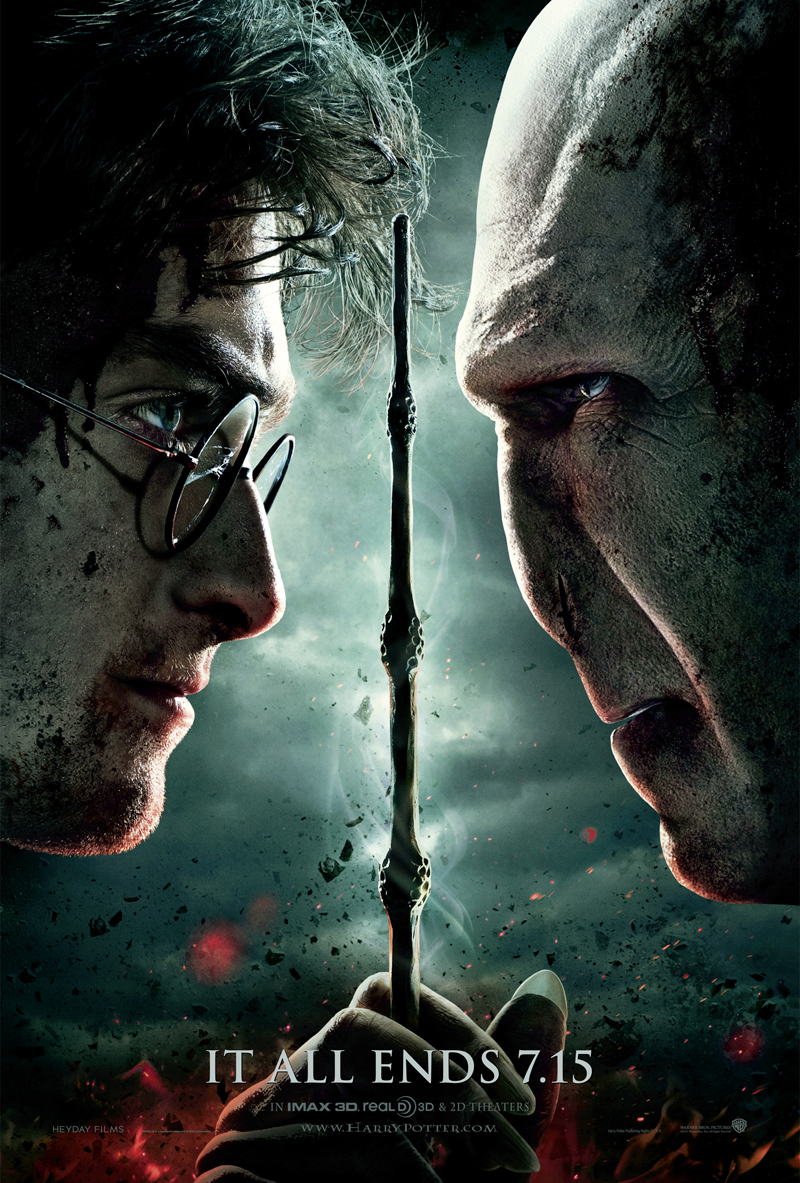
good vs. bad, east vs. west, weak vs strong. This theory becomes more clear to us when we use it in a film. For example "Harry Potter" shows us very clearly how there is a distinct example of 'Harry' being the good guy and 'Voldemort' being the bad guy, in these films. The picture to the right is an advertisement of the film and it clearly shows the audience who is the bad guy and who is the good guy. This example of good vs bad could also be an example of old vs young.

-Vladimir Propp is the fifth and final theory i will be talking about. Propp believed that there are only different character types. he come to this conclusion by analysing old folk stories. He stated that the 8 character types are as follows:
-Hero
-Villain
-Helper
-Donor (Provider)
-Father
-Dispatcher
-Princess
-False Hero
An example of this theory being used is in the film "Harry Potter". The hero would be Harry, the villain would be Lord Voldemort. The helper in this film would either be Ron Weasley or Hermione Granger, the father figure would be Hagrid and the princess would be Cho Chang.


A lady called Laura Mulvey had the opinion that women were viewed in a certain way in cinema and her theory was called The Male Gaze. She used the film 'Rope' to support her analysis. She believed that in the film 'Rope' women were viewed as the objects of male erotic desire and that men were the active ones while women were presented as passive. She also stated that from this film she could sense that women do not have an agency as they do not move the plot forward. She said that the audience if forced to identify with Male Gaze and that cinema reflects Partriachal(male dominated) society. The Pstriatchy and phallocentrism linked the penis as a symbol of a gun.

Monday, 13 October 2014

Sound Excersie & Evaluation


This sound exercise involved us actually practising what we had previously learnt during our class lesson. In this film we used diegetic, non-diegetic, parallel, dialogue and music.

As a group we decided to put in peaceful and happy music at the start to set out a calm vibe of two friends meeting up discussing the party they both attended last week. We then added in a flashback of Denis dancing on the table. To do this we had to add non-diegetic flashback music that we got from YouTube. Whilst Denis was dancing we added the 'Barbie' music which we also downloaded from YouTube. Later on in the short film we felt that sirens should be added as they would fit in with the scene of David being arrested, this siren noise you hear in the background is diegetic sound.

Looking back on this sound exercise I believe it went well as we were able to use all different types of sound effectively for example our non-diegetic and diegetic sound was all edited in well matching what was going on in this short sketch. I think there was really only one thing wrong with this sound exercise task and that was the microphone being shown accidentally in most scenes. Using this mistake and learning from it is most important so when making our final thriller piece me and the people in my group will have to make sure that the microphone can not be seen.