-The first media theory is the traditional hollywood structures that states in all film there is a 3 act structure, which is 25% of the film left to set up the beginning, 50% of the film as the confrontation where everything happens and the plot reveals itself. The last 25% is for the climax of the final part of the film. This structure is said to be always in this chronological order and if there are any sub-plots then these will have a tendency to happen near the end of the film.
-The second media theory i am going to be looking at is the Todorov narrative theory. His theory suggests that the stories begin with an equilibrium where any opposing forces are in balance. This equilibrium is then disrupted by an event leading to a series of other events which would then lead to the stereotypical end of all major events being restored. This theory basically states that every film has 5 stages of equilibrium, which are as follows;
1. A stage of equilibrium, all is as it should be.
2. A disruption occurs
3. A recognition that brings disorder.
4. An attempt to repair the damage.
5. A return, resolution or a new equilibrium.
 An example of this theory is the film 'Avatar'. Firstly the Navi people are at war with the human people and jake sully, the main character, is sent to learn there ways by becoming a part of their tribe and connect with them. The second stage is when a disruption of some sort occurs which in this film is the human people planning to destroy the 'Hometree' which is a sacred place to the Navi people. Stage three is a recognition that brings disorder which in this film is the 'Hometree' being destroyed. The four stage of this theory is an attempt to repair the damage or in tis case fight back, Jake Sully tries to unite the navi people and his human friends to fight back against the humans trying to destroy the navi people's planet Pandora. The fifth stage is he new equilibrium which is jake sully deciding to stay in his avatar body forever.
-The third theory i am going to be talking about is Roland Barthes theory of Enigmas meaning mystery. He believed that each person that looks at the text receives and interprets it in a different way, therefore several different meanings can be made from it. All texts are 'complex' bundles of meanings. For example an open piece of text which is not resolved at the end, a closed text which is resolved at the end. Another example is a Polysemic text which has lots of different meanings.
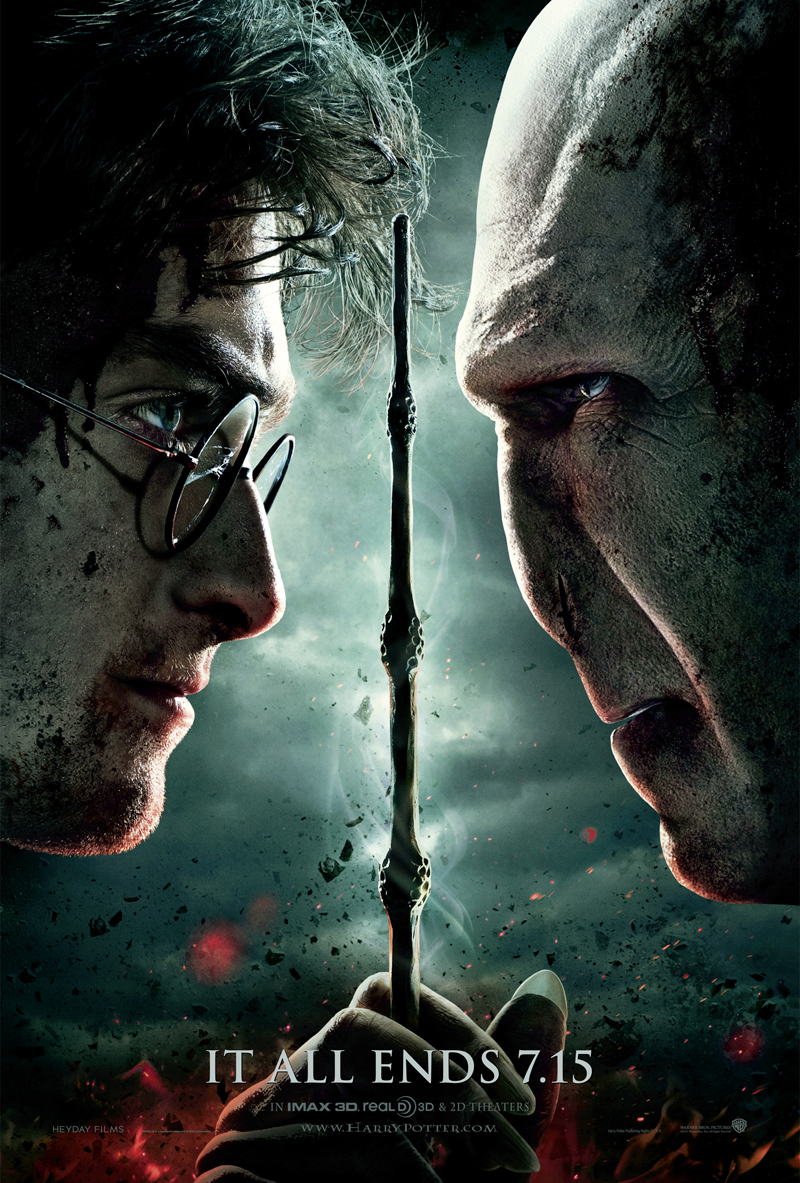 -The fourth theory i am going to be looking at is the Levi Strauss Binary opposites theory. Binary opposites focus on different sets of opposite values which reveal the structure of the media texts. His narrative theory is different compared to other theorists as he focused more on the arrangements of the themes rather than the order of a media text. An example of these Binary opposites are as follows;
good vs. bad, east vs. west, weak vs strong. This theory becomes more clear to us when we use it in a film. For example "Harry Potter" shows us very clearly how there is a distinct example of 'Harry' being the good guy and 'Voldemort' being the bad guy, in these films. The picture to the right is an advertisement of the film and it clearly shows the audience who is the bad guy and who is the good guy. This example of good vs bad could also be an example of old vs young.
-Vladimir Propp is the fifth and final theory i will be talking about. Propp believed that there are only different character types. he come to this conclusion by analysing old folk stories. He stated that the 8 character types are as follows:
-Hero
-Villain
-Helper
-Donor (Provider)
-Father
-Dispatcher
-Princess
-False Hero
An example of this theory being used is in the film "Harry Potter". The hero would be Harry, the villain would be Lord Voldemort. The helper in this film would either be Ron Weasley or Hermione Granger, the father figure would be Hagrid and the princess would be Cho Chang.
A lady called Laura Mulvey had the opinion that women were viewed in a certain way in cinema and her theory was called The Male Gaze. She used the film 'Rope' to support her analysis. She believed that in the film 'Rope' women were viewed as the objects of male erotic desire and that men were the active ones while women were presented as passive. She also stated that from this film she could sense that women do not have an agency as they do not move the plot forward. She said that the audience if forced to identify with Male Gaze and that cinema reflects Partriachal(male dominated) society. The Pstriatchy and phallocentrism linked the penis as a symbol of a gun.

Well done.Detailed and thorough
ReplyDelete